Houseplant coloring pages
from an authorized photo
Explore houseplant coloring-page ideas with practical photography, outline and palette advice. Learn how to prepare an authorized image and check your print.
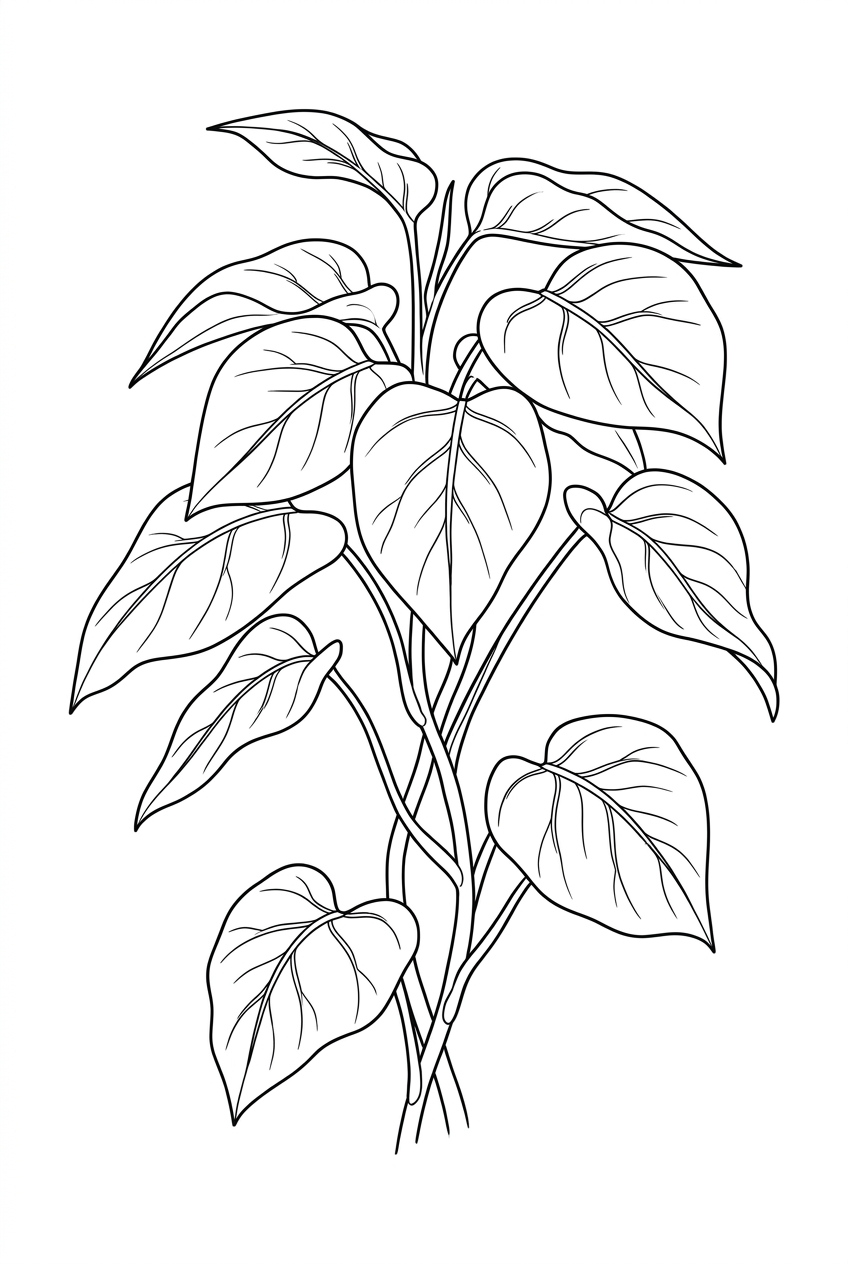
Draw or color this page for personal use. The outline is drawn from a photograph released for this guide. At this size it prints cleanly at A5, and softly at A4 — check one sheet before making copies.
- Sheet
- A4 · 210 × 297 mm
- Resolution
- 848 × 1264 px · ≈ 103 DPI at A4
- Licence
- Personal use · no resale
Free, no sign-in. Downloads stay available while the artwork is published.
Want this from your own photo?
Upload a photo you own and get a clean line drawing at A4, 300 DPI. Three free drafts a day, no card.
Create a coloring pageThe guide
Everything the page needs before you print it.
Prepare your houseplant photograph
Choose a plant with separated leaves and photograph it against a plain wall. Turn the pot gently only if it is safe to do so. Include the full leaf tips and container base. Strong backlight may turn the leaves into silhouettes and hide useful details. Check the photograph at its original size before choosing it: the main edges should be visible without sharpening filters. Crop away unnecessary surroundings while retaining the full subject. A clear source gives you a better starting point, but it does not guarantee a particular generated result.
Choose useful houseplant outlines
Keep the characteristic leaf shape, a few central veins and the main stems. Remove small leaf blemishes from the drawing rather than treating them as essential outlines. For a climbing plant, arrange the composition around one visible vine instead of a confusing bundle of supports. Think about the page at the size you will actually print, rather than judging only a zoomed screen view. Larger enclosed areas suit a relaxed session; a more detailed outline takes longer to color. Inspect the candidate for missing, doubled or confusing edges before treating it as finished artwork.
Plan a houseplant palette
Build a palette of two greens with one neutral pot color. For variegated leaves, reserve light areas before shading the darker sections. Repeat the same treatment across leaves facing a similar direction, so the plant looks cohesive rather than randomly patterned. Keep a small swatch beside the page and build color in light layers. The photograph can guide your choices, but you can also make an intentional decorative interpretation. Test your pencils or pens on the same paper first, because paper texture and ink coverage change how colors appear.
Try a focused coloring exercise
Use a spare leaf outline to test a central vein highlight. Then compare solid green with a two-tone version. On the full page, color the large leaves first and use the smaller leaves to repeat the same balance of light and dark. Set aside a small practice area instead of experimenting immediately on the most important feature. Pause after the first layer and view the sheet from a normal reading distance. You can leave some areas white; a completed page does not require filling every space or reproducing every photographic shadow.
Check the print and permissions
Inspect the actual downloaded pixel dimensions before printing this houseplant page. A4 is 210 by 297 millimeters; a full A4 raster at 300 pixels per inch is approximately 2480 by 3508 pixels. A larger export canvas alone does not prove that the source has that much detail. Use an A4 PDF at its intended page size, check the printer preview for clipping, and test one sheet before making copies. Do not remove healthy leaves to make the composition simpler. Use only photographs you own or are explicitly authorized to adapt. Do not upload minors, celebrities, strangers or restricted material.
Questions
Before you print.
Answers written for this guide. If a page still looks wrong at print size, do not print a stack of copies.
Should a support pole stay in a houseplant page?
Keep it if it explains the plant’s position and has a simple outline. If it hides many leaves, choose another camera angle instead of expecting the conversion to reconstruct them.
How should I check a houseplant page before printing?
Inspect the houseplant outline at normal page size for unclear edges and small crowded areas. Check the file’s actual pixel dimensions, use the intended A4 page size when available, and print one test sheet. An enlarged file is not proof of additional original detail.
What is a useful practice exercise before coloring a houseplant page?
Use a spare leaf outline to test a central vein highlight. Then compare solid green with a two-tone version. On the full page, color the large leaves first and use the smaller leaves to repeat the same balance of light and dark.
Plate 09 — Your turn
Your next bestseller starts as a photo.
Three free drafts, no card. Print files cost credits from the standard tier up.
Create a coloring page